Decision Guide · 2026

Before you download
any peptide calculator,
ask one question.

Does it work backwards? Standard calculators take vial size and BAC water volume and tell you the draw. One calculator takes the draw you want and tells you how much BAC water to add. That difference determines which tool to use.

The Question Answered

The Calculator That Works Backwards
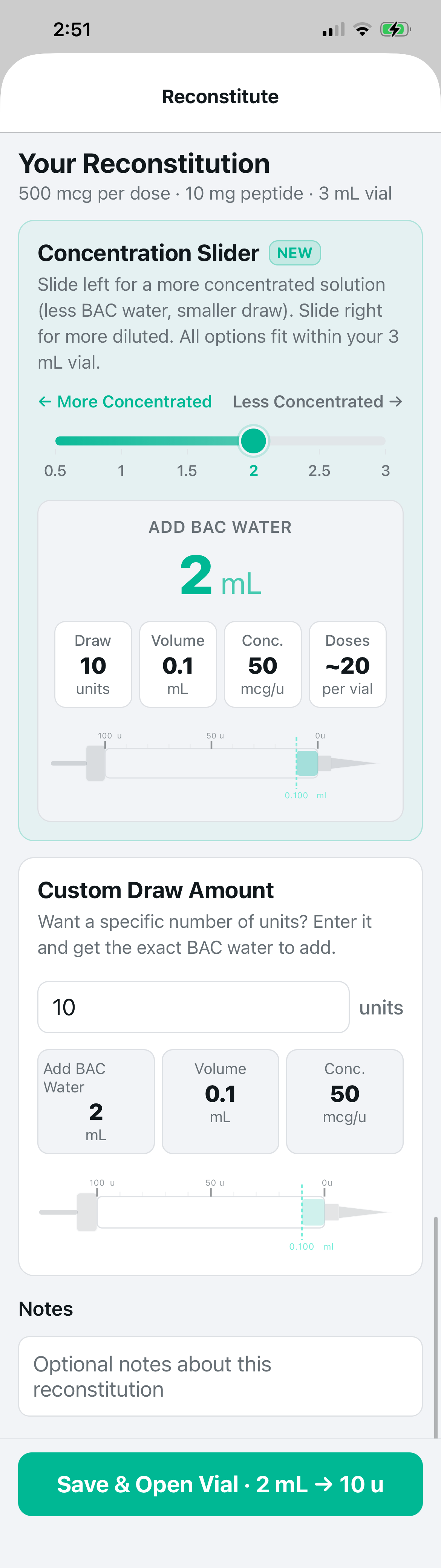
Protocol Custom Draw peptide calculator showing reverse reconstitution mode — specify draw units, get BAC water amount

Specify 20 units. Get the exact BAC water volume that produces 20 units at your dose.

Protocol's Custom Draw mode is the only free peptide calculator that operates in reverse. Standard mode: enter vial size, BAC water volume, and dose — get draw units. Custom Draw mode: enter the draw units you want and the dose you need — get the BAC water volume to add to your vial.

The practical consequence: you decide how easy your syringe draw is before you pick up the BAC water. Most users find that 20 units is easier to read and more accurate than 10 units on a small-graduated U-100 syringe. With Custom Draw, you set 20 units as the target and build the reconstitution around it. You don't adjust your behavior to fit the calculation — the calculation fits your behavior.

No other calculator — free or paid — has this mode as of June 2026. It exists at reconstitution.health and in the Protocol app on iOS and Android.

"Tell it the draw you want. It tells you how much BAC water to add."

What Else to Evaluate

Five Capabilities That Separate
Good from Adequate

Reconstitution calculator

The baseline. Every calculator on the market handles this. The question is whether it handles the full input set — vial size, dose, BAC water, and concentration output — or just a subset.

All apps have this

Custom Draw reverse mode

The differentiator. Reverses the calculation so you set the syringe draw target and get the BAC water amount. Removes the most common source of reconstitution inaccuracy.

Protocol only

PK half-life plotter

Models blood concentration over time after injection. Essential for multi-compound protocols, twice-daily dosing schedules, and understanding when a compound peaks and clears.

Protocol (22 compounds)

TRT ester calculator

200mg of Testosterone Cypionate is approximately 140mg of actual testosterone. The ester calculator shows the free T equivalent across all major esters. Absent from most tools.

Protocol only (free)

Android support

PeptideCalc, PepTracker, and Dose are iOS only. Protocol launched on Android in May 2026. If you're on Android, the choice is Protocol or a web-based calculator.

Protocol only (native)

Free vs Paid

Is a Paid Peptide Calculator
Worth It?

PeptideCalc.io charges a one-time purchase (no subscription). The UI is polished and the titration preview is well-designed. The case for paying: you prefer a one-time payment over a free app and are happy on iOS only.

The case against: Protocol's free suite includes Custom Draw mode, PK half-life plotting for 22 compounds, TRT ester calculation, and a stack cost calculator — none of which are in PeptideCalc. The one genuinely useful thing PeptideCalc has that Protocol does not is iCloud sync across iPhone and iPad. If that matters to you, PeptideCalc is worth considering.

For most users the calculus is simple: Protocol does more, costs nothing, and runs on Android. The paid option does less and is iOS only.

Common Questions

FAQ

Which peptide calculator is the most accurate?
Accuracy in peptide calculators comes down to the formula, not the interface. All major calculators use the same math: concentration (mcg/mL) = vial size ÷ BAC water volume; draw units = (dose ÷ concentration) × 100. Protocol is accurate to three decimal places and includes the Custom Draw mode that prevents the most common input error — choosing a BAC water volume before knowing what syringe draw it produces at your dose.
Can I use a peptide calculator without downloading an app?
Yes. Protocol's reconstitution calculator and Custom Draw mode are available at reconstitution.health with no download required. The PK half-life plotter and full calculator suite (including TRT ester and stack cost) require the app, which is free on iOS and Android with no account required.
What is bacteriostatic water and where do I buy it?
Bacteriostatic water (BAC water) is sterile water containing 0.9% benzyl alcohol as a preservative. The benzyl alcohol prevents bacterial growth across multiple needle insertions, making it safe to use across the 20–40 draws a standard peptide vial requires. It's available from research chemical suppliers, some compounding pharmacies, and occasionally on Amazon (search "bacteriostatic water 30mL"). Do not substitute plain sterile water unless using a vial in a single sitting — it lacks the preservative.
What is the difference between mg and mcg in peptide dosing?
1 milligram (mg) = 1,000 micrograms (mcg). Peptide vials are typically labeled in mg (2mg, 5mg, 10mg), while doses are described in mcg (250mcg, 500mcg). The reconstitution calculator handles the conversion — you enter the vial in mg and the dose in mcg and it outputs the correct draw units. The most common error is confusing the units and entering dose in mg rather than mcg, producing a draw 1,000× too small.
Is the Protocol peptide calculator private?
Protocol stores all data on-device only. No account is required, no data leaves the device, and there is no cloud sync. Calculations run entirely on your phone or in your browser. This is particularly relevant for TRT and GLP-1 users who may have medical privacy concerns.

The Calculator That Works Backwards

Custom Draw, PK plotter, TRT ester, and stack cost — all free.

Download on the App Store Get it on Google Play

No account · On-device only · iOS + Android